Showing posts with label leaves. Show all posts

Saturday, 21 September 2013

Climate Change Leaves Hares Wearing The Wrong Colors

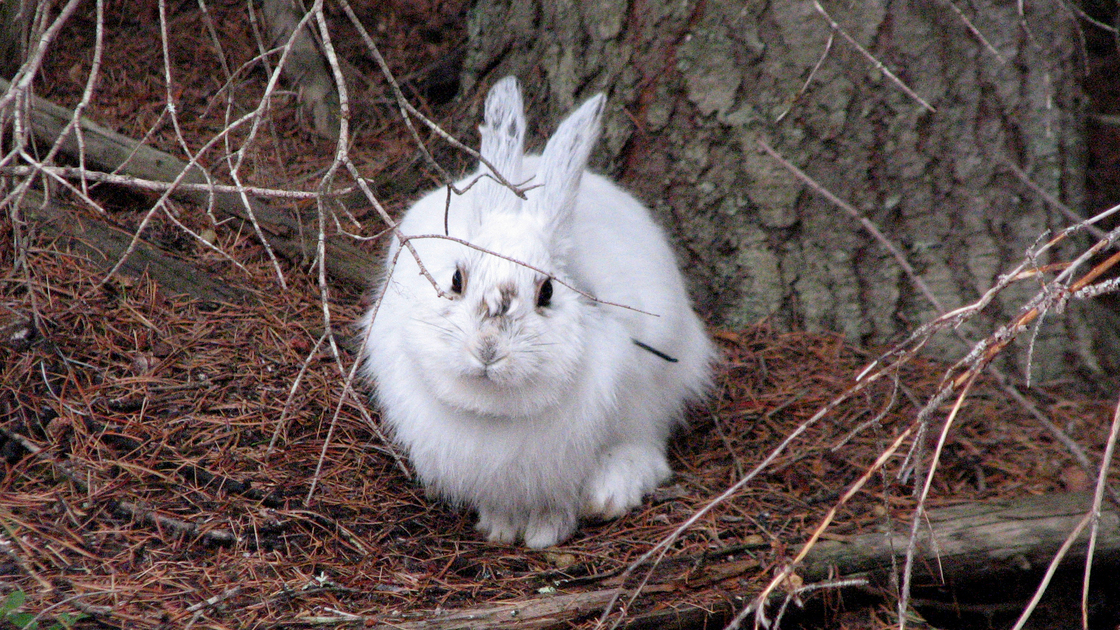
A white snowshoe hare against a brown background makes the animal easy prey.

L.S. Mills Research Photo A white snowshoe hare against a brown background makes the animal easy prey. A white snowshoe hare against a brown background makes the animal easy prey.
L.S. Mills Research Photo

The effects of climate change often happen on a large scale, like drought or a rise in sea level. In the hills outside Missoula, Mont., wildlife biologists are looking at a change to something very small: the snowshoe hare.

Life as snowshoe hare is pretty stressful. For one, almost everything in the forest wants to eat you.

Alex Kumar, a graduate student at the University of Montana, lists the animals that are hungry for hares.

"Lynx, foxes, coyotes, raptors, birds of prey. Interestingly enough, young hares, their main predator is actually red squirrels."

Yes, even squirrels. Kumar and field technician Tucker Seitz spend months searching these woods for hares. Seitz is wearing a T-shirt with their mascot — a pink bunny.

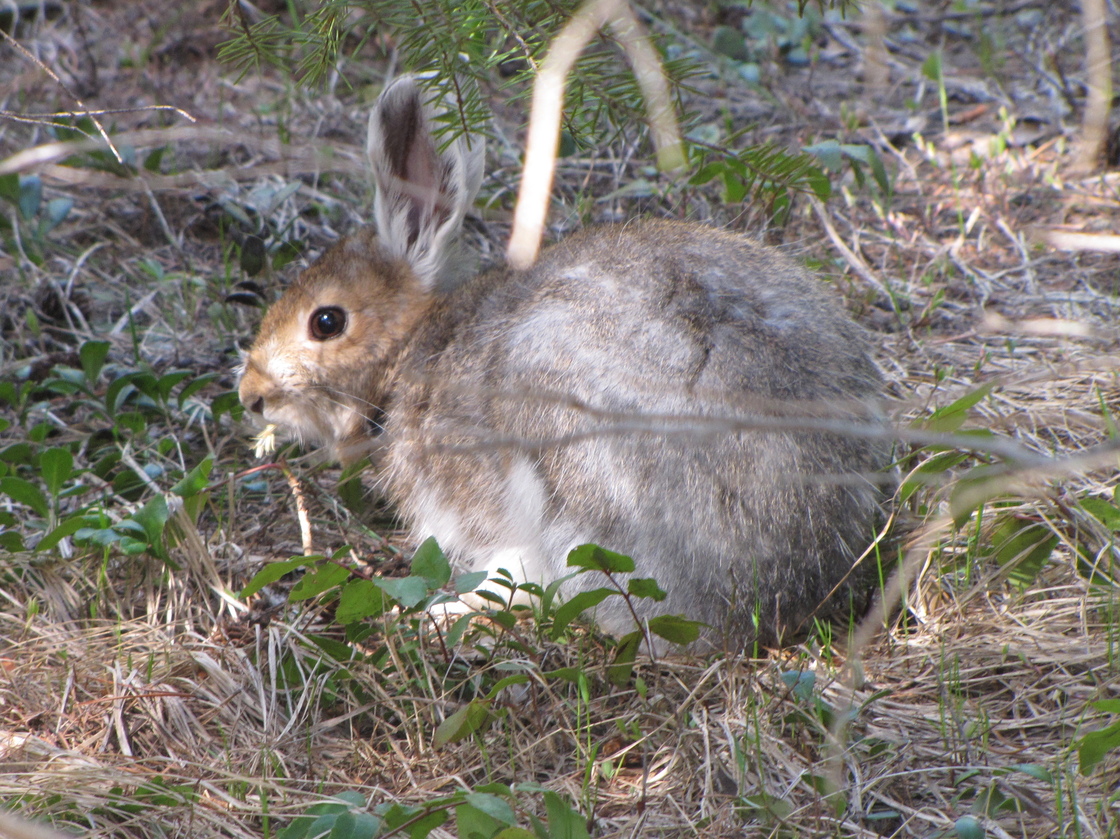
A hare with fur to match the season is almost impossible to see.

L.S. Mills Research Photo A hare with fur to match the season is almost impossible to see. A hare with fur to match the season is almost impossible to see.
L.S. Mills Research Photo

"Yep, we embrace the pink bunny," Kumar says.

"There's pink bunnies on all of our trucks," Seitz adds.

We'd spotted a hare in the brush just as we drove up — light brown with large back feet.

Kumar listens for signals from hares they've already put radio collars on.

They catch other hares with wire traps about the size of a breadbox, with some apple as bait. Most of the hares they track live less than a year — a hazard of being what Kumar calls "the cheeseburger of the ecosystem."

But snowshoe hares have a trick up their sleeve: camouflage. They're brown during the summer, but turn stark white for the snowy winter months. Kumar says it works.

"There's times when you're tracking them and you know they're really, really close, and you just can't find them," he says.

Hares switch color in the spring and fall in response to light, when the days get longer or shorter. But that means they're at the mercy of the weather. If the snow comes late, you get a white hare on brown ground.

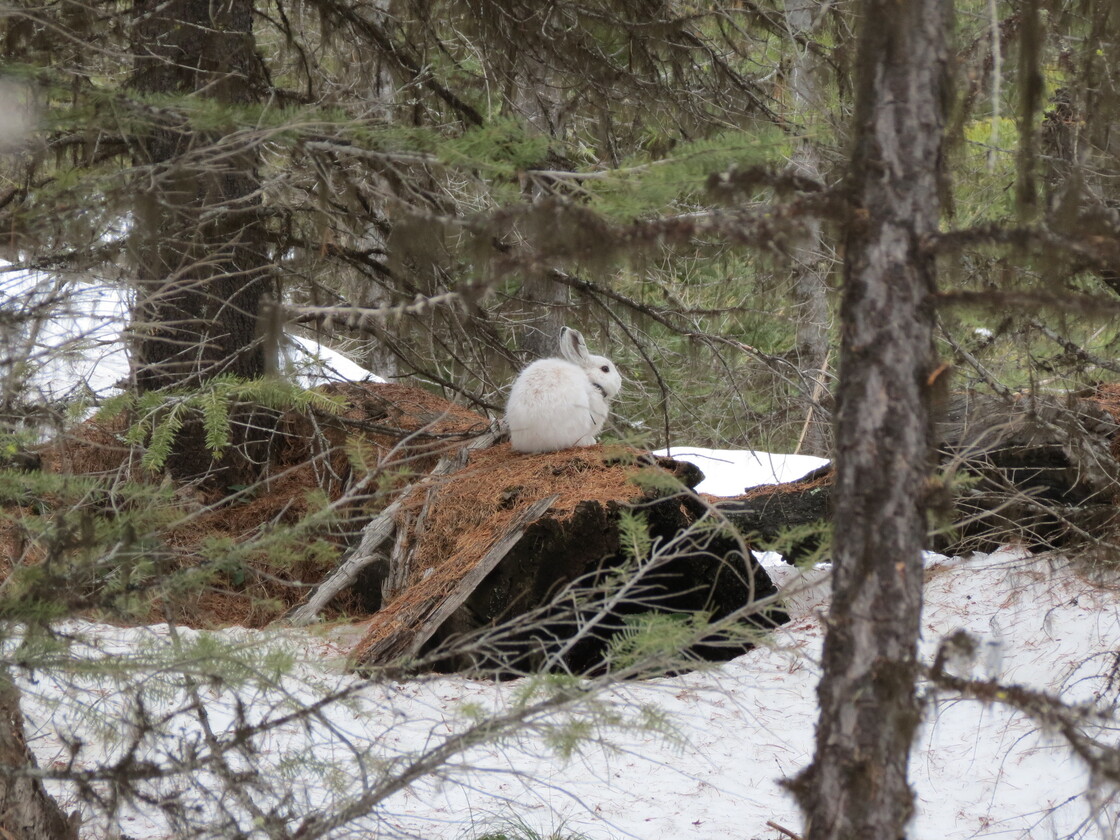
A snowshoe hare in the Montana woods.

L.S. Mills Research Photo A snowshoe hare in the Montana woods. A snowshoe hare in the Montana woods.
L.S. Mills Research Photo

"And they really think that they're camouflaged," Kumar says. "They act like we can't see them. And it's pretty embarrassing for the hare."

Kumar calls this "mismatch," and it's becoming more of a concern with climate change.

"If the hares are consistently molting at the same time, year after year, and the snowfall comes later and melts earlier, there's going to be more and more times when hares are mismatched," he says.

Scott Mills of North Carolina State University leads the research. He says they're finding that mismatched hares die at higher rates. That's a concern for the threatened Canada lynx, which mainly eats these hares.

"It's a picture that paints a thousand words," Mills says. "It's a very clear connection to a single climate change stressor."

Mills says hares might be able to adapt over time. Some snowshoe hares in Washington State don't turn white at all. Mills is trying to figure out whether hares and other wildlife can adapt as fast as the climate is changing.

"But really what we don't know very well is how fast is too fast?" he says.


View the original article here

Tuesday, 20 August 2013

Review: Plants vs Zombies 2 sticks to its roots, but paywall leaves us feeling dead inside

A man wearing a steel pot for a hat tells you that he wants to enjoy the taco he just ate again, so he's going back in time with the help of his talking camper. That's essentially the plot of Plants vs. Zombies 2, the long-awaited sequel to the much beloved tower defense game that pits vegetation against the undead. This time your adventures in gardening take you to Ancient Egypt, 17th-century pirate-infested waters, and eventually the Old West. Despite a freemium model that nearly spoils the crop, PvZ2 is still a blue-ribbon mobile title with a charm and humor that is beyond garden-variety.

Plants vs Zombies 2 eschews the linear formula of the first-game for a more classic board game format. While you’ll still deploy little planted peapods and sunflowers to confront rows of bumbling zombies, the levels exist in a larger world now and beating a stage unlocks another along the path. There are forks in the road that let you decide how you'd like to proceed, and even keys to find that open up new areas. Ultimately your goal is to work your way to a star gate which takes you to the next world.

The pirate-themed world in PvZ2

Instead of simply defeating several sequences of increasingly complex and uniquely-powered zombies, the main campaign has some welcome variety in “last-stand” challenges, maps with specific restrictions, and new world-specific enemies. You’ll slay tombstone-raising zombies in Egypt and later confront undead sea captains with their nefarious parrots and rope-swinging brethren. While the pacing suffers into lulls at times, the overall experience is more varied and full than the original, thanks in large part to the scale: Now you’re no longer just a homeowner, you’re a time-traveling adventurer.

To respond to these new threats and challenges, your botanical arsenal has been augmented with bloomerangs, coconut cannons, iceberg lettuce, and adorable “spring” beans among others. The character design is as charming as ever, with the plant almanac full of chuckle-inducing introductions and adorable biographies. The art is also much improved over the first first title, with superior animations, worlds, and environmental effects.

Your green thumb also gets a huge upgrade: Now you can also feed your plants special plant food that will give them temporary boosts. Sunflowers spit out a huge amount of sun, while peashooters suddenly become gatling-gun-like repeaters that level everything in their path. Experimenting with the different upgrades and unleashing them in timely fashion is one of the best new elements of Plants vs Zombies 2.

Familiar faces make an appearance, but there are plenty of new plants to play with, too.

One element that doesn’t feel quite at home is the new god-like powers that you can now utilize. While before you were merely a homeowner with an undead problem, time travel somehow gave you the ability to flick zombies off screen, pinch their heads, or strike them dead with lightning. While relatively easy to deploy via the touchscreen, they make any mission a near-walk due to their sheer power. Thankfully, they’re somewhat expensive to purchase using the in-game currency, but if you’re willing to throw down real money, you’ll find the game much, much easier.

This ability to pay money to make the game easier is a common trope of modern iOS games, but with PvZ, a franchise that prides itself on strategy and clever-thinking, such free-passes seem blasphemous. The main issue players will have with PvZ2 is likely dependent on how much they care about the freemium model’s awkward game balance issues. Developer PopCap had to satisfy fans of the series who have come to expect certain gameplay elements, while publisher EA likely pushed for every opportunity to squeeze more money from the player. The result is a game that can be completed without paying, but seems to punish you in every way imaginable if you choose not to.

The game's in-app purchases aren't exactly a high-point.

If you’re playing without paying, you’ll see many of your favorite plants locked away behind paywalls ($3 for squash!?), you’ll have to trudge through levels again and again to mine for stars (which are used to open star gates), and you’ll be handicapped in the use of your super powers. The game is simply a much longer, thinner, and monotonous experience if you decide to keep a tight hold on you wallet. Meanwhile, if you throw down some money, you can use your godlike powers with impunity, have access to the full arsenal of plants, and unlock new worlds instantly. But it’s not just a few dollars, it’s a lot of money: Unlocking every plant will cost you about $20, while unlocking a new world will cost you $5. It just feels like needlessly milking a fanbase that is already falling over itself to buy your game.

Despite my qualms with the freemium model, PvZ2 remains an exceptional, charming tower defense title that expands on the original while taking you in new and exciting directions. So strap on your steel pot helmet, grab some fertilizer: You’ve got some zombies to kill.


View the original article here