Showing posts with label latest. Show all posts

Tuesday, 3 September 2013

The Latest In Scientific Field Equipment? Fido's Nose

Dave Vesely is busy training his dog, Sharpy. She isn't learning to sit, or fetch or even herd sheep — Sharpy is learning to find the nests of Western Pond Turtles.

These turtles are sneaky. After laying their eggs in a small hole, they knead together dirt, leaves and their own urine to plug the opening. Once this mud dries, the nest looks like an unremarkable patch of ground.

But that kind of stealth can't protect the turtles from urban development. The Western Pond Turtle is disappearing from the Pacific Northwest as its native habitat is claimed by humans.

Vesely, who works at the Oregon Wildlife Institute, hopes to give the turtles a fighting chance. To keep foxes and raccoons away from their tasty eggs, he can place small metal cages over the nests. But first, he has to find them.

"It's almost impossible," Vesely says. "After just hours and hours of walking across fields looking for nests, it just occurred to me — I've got a dog at home that could probably do this better than I can."

Vesely and his wife own five Groenendaels — big, furry Belgian sheepdogs, jet black from nose to tail. Millions of years of evolution have shaped these dogs into excellent predators, with eyes that pick up movement in dim light, sensitive ears and an incredibly powerful nose.

Sharpy, Heart, Rocky, Knife, Rogue

Sharpy, Heart, Rocky, Knife, Rogue

Rob Finch

Vesely is trying to leverage those predatory powers to save a species other canids eat. He's taught Sharpy to associate the smell of turtles with playtime, and now he's running her through training courses, where several turtle-scented objects have been hidden in a grassy field.

Sharpy weaves back and forth, her tail wagging, searching for a scent plume. When she gets that first whiff of turtle, her body whips around, and she follows the smell to its source. Then she plops down and looks to Vesely for her reward — a couple minutes of tug-of-war.

"Nice find for a beginner dog," Vesely tells her.

The Nose Knows

Dogs can detect the smell of diseased bees, ovulating cows, pirated DVDs and cancer. It's all thanks to their top-notch sensory equipment.

An infographic exploring canine sensory equipment. Adam Cole/NPR

"The dog just has hundreds of millions more receptors lining the pathways of [its] nose than we do," says Alexandra Horowitz, a dog cognition expert at Barnard College.

And the part of the brain that makes sense of all the signals from these receptors — the olfactory bulb — is much larger in dogs than in humans.

"That probably means [dogs have] exponentially more ability to detect odors," Horowitz says.

Her book, Inside of a Dog, contains a dramatic example of canine olfaction.

"So you have an Olympic size swimming pool full of water and then you have an identical pool full of water to which you add a teaspoon of sugar. They can detect the difference," Horowitz says. "That smells different to them."

Scent-Centric World

Dogs encounter the world nose-first, so their world is probably very different from our own. We tend to perceive smells in very coarse black and white. There are good odors and bad odors and then a large category of odors we just can't detect.

But for dogs, everything has a scent, and all scent is information. Smells that would make us retch are just interesting to a dog. Overlaid on the visual landscape is the incredibly detailed terrain of smells. Luckily for humans, dogs are one of the few species willing to share their world with humans.

"Bears have a great sense of smell, but it would be really difficult to find a bear that wants to tell you consistently what it knows," says Megan Parker, who has made a living finding out what dogs know.

In 2000, Parker helped create Working Dogs for Conservation, a group of biologists and dogs that travel the world, studying rare, endangered and invasive species.

The company was born out of frustration. Parker says many field biologists spend their careers trying to get samples from extremely rare and reclusive species.

"I thought, 'There's got to be a better way,' " she says."For us, dogs are that better way."

The dogs have found poop containing DNA samples from rare animals up in trees, under the water of fast-flowing creeks, and buried by dung beetles.

"Just watching a dog respond to all the things out there you get just the tiniest, tiniest sense of how they experience the world," Parker says.

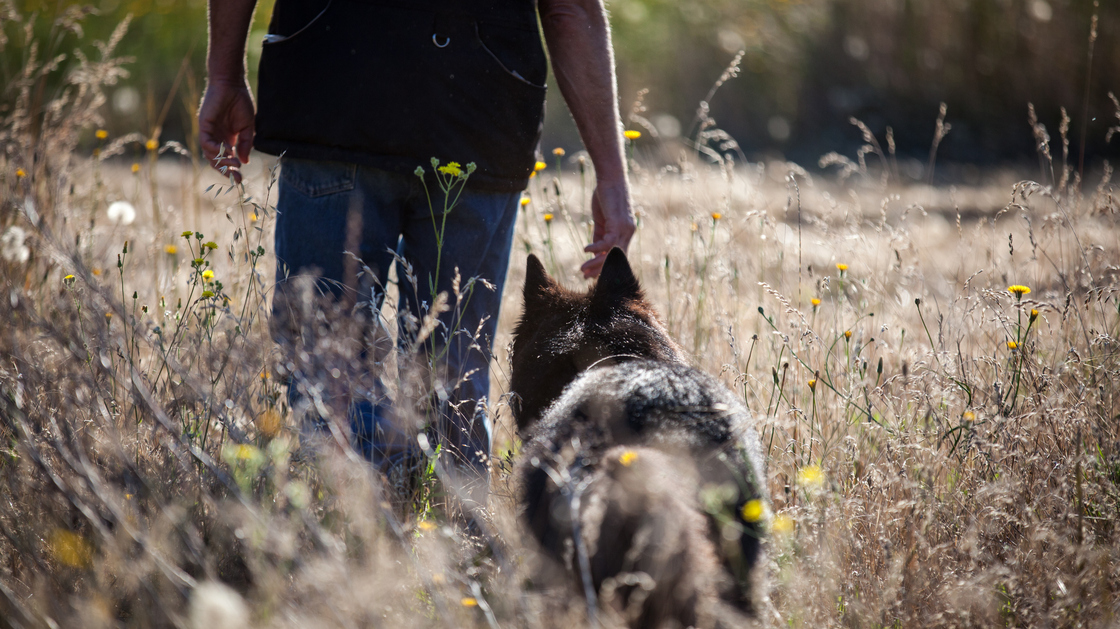
Vesely and Rogue head into the field to demonstrate the dog's ability to search for Western Pond Turtles.

Rob Finch for NPR Vesely and Rogue head into the field to demonstrate the dog's ability to search for Western Pond Turtles. Vesely and Rogue head into the field to demonstrate the dog's ability to search for Western Pond Turtles.
Rob Finch for NPR

Do What You Love

Many of the dogs employed at Working Dogs For Conservation aren't bred for detection work — they come from the pound.

"The reason these dogs are in shelters is because they would make really poor pets," Parker says. "They're obsessed by a toy to sometimes an incredible extent — like, they will jump through a plate glass window to get to a ball outside."

That incredible "toy drive" means they have the focus and motivation to work a full day.

"These are the rare dogs that will be consistently good across long days and a harsh field environment as well across their career," Parker says. "They're just going to love this job their whole life."

Scientists and conservationists around the world have embraced detection dogs — so much so that a new organization (the International Conservation Detection Dog Association) has been formed to help certify dogs and handlers, and standardize training and search techniques.

The popularity of the dogs isn't hard to understand. They speed up a tedious process ... and they're the only piece of field equipment that can wag.

Listen to dog handlers Megan Parker and Dave Vesely sharing tales about their canine coworkers.

Dave Hamman/Working Dogs for Conservation

Pepin the Belgian Malinois chases down cheetah scat in Zambia. His handler Megan Parker explains that the work was tough, but there were occasional causes for celebration.

Dave Vesely trained his dog Rogue to find Kincaid's Lupine, a rare flower that houses the eggs of an endangered butterfly. As Dave explains, Rogue was more competent than his handler in the field.

Wicket, seen here, traverses a Wyoming stream in search of moose poop. Megan Parker describes a typical day in the field, from a dog's perspective.


View the original article here

Saturday, 24 August 2013

Tech firms' responses to latest NSA disclosures cloud the truth, experts say

Technology companies may be hiding behind legal jargon to avoid being more forthcoming in their responses to new documents on government surveillance that were disclosed Friday, some experts say.

Internet and software companies including Microsoft, Yahoo, Google and Facebook “are legally compelled to lie,” said security expert Bruce Schneier, citing national security letters that companies are prohibited from disclosing.

Some similar statements were made in interviews with the IDG News Service following a report published Friday in The Guardian alleging that the National Security Agency paid millions of dollars to companies such as Google and Facebook to cover costs involved in surveillance.

The tech companies incurred these costs in fulfilling tighter certification requirements after a 2011 court ruling said the government’s data collection was unconstitutional, according to documents obtained by The Guardian.

That ruling, which was handed down by the Foreign Intelligence Surveillance Court and was made public on Wednesday, said that the way the NSA collected data violated the Fourth Amendment because the agency did not effectively design its collection efforts to target only foreigners of interest to national security.

The NSA was “misusing its authority” by collecting the digital communications of U.S. citizens for years, the ruling said.

The documents revealed Friday describe the problems that the agency experienced after that ruling and the resulting efforts required to bring companies into compliance, according to The Guardian. The list of involved companies includes Google, Yahoo, Microsoft and Facebook, its report said.

The documents were passed on to The Guardian by former NSA contractor Edward Snowden, the man behind the original leaks of various government surveillance programs such as Prism. The documents provide the first evidence of a financial relationship between technology companies and the NSA, the Guardian report said.

The FISA court is required to sign annual certifications that provide the legal framework for surveillance operations, the report said. After the 2011 ruling, those certifications were only being renewed on a temporary basis as the NSA worked to fix its data collection methods that the court deemed unconstitutional.

This adjustment process entailed huge costs, according to a 2012 NSA newsletter entry, excerpts of which were published by The Guardian. “Last year’s problems resulted in multiple extensions to the certifications’ expiration dates which cost millions of dollars for Prism providers to implement each successive extension,” the newsletter said.

The Guardian did not give an exact figure for the costs.

The latest disclosure raises serious questions around the use of taxpayer money to finance government surveillance, the Guardian said. But another issue is the growing discrepancy between the information contained in leaked government documents and technology companies’ responses to it.

Snowden’s original leaks revealing Prism described a program aimed at the mass collection of data owned by U.S. citizens through direct access to company servers. Google and other tech companies have denied cooperating with the NSA to allow the mass collection of data.

They gave similar denials on Friday in response to questions from the IDG News Service.

“Facebook has never received any compensation in connection with responding to a government data request,” a Facebook spokeswoman said.

“We think the continued misreporting on this matter by The Guardian and others is troubling,” she added in an email.

Google said it has “not joined Prism or any government surveillance programs.”

“We do not provide any government with access to our systems and we provide user data to governments only in accordance with the law,” a spokeswoman said.

Both Yahoo and Microsoft offered more legalistic, complicated responses. Their responses make it clear that the companies’ deals for government compensation are more complicated than something they can simply confirm or deny.

“Microsoft only complies with court orders because it is legally ordered to, not because it is reimbursed for the work,” a spokesman said. “We could have a more informed discussion of these issues if providers could share additional information, including aggregate statistics on the number of any national security orders they may receive,” he said.

Microsoft asked for permission in June to aggregate statistics about the number of requests for data it receives under the U.S. Foreign Intelligence Surveillance Act.

Currently, companies can reveal the number of FISA requests they receive only if they lump them together with all other requests from U.S. law enforcement agencies.

Yahoo said it had nothing to add beyond the statement that the company supplied to The Guardian, which said “federal law requires the U.S. government to reimburse providers for costs incurred to respond to compulsory legal process imposed by the government.”

“We have requested reimbursement consistent with this law,” the company said.

Semantics are at play in companies’ responses, experts said.

Friday’s leaked documents “say that these companies cooperate with bulk NSA data collection,” said Schneier. “The companies deny it, but their denials are precisely worded with a lot of wiggle room,” he said.

Also, if companies are compelled by a National Security Letter to comply, they are prohibited from talking about their compliance, Schneier said.

In its response Friday, Google said it continues to await the government’s decision on the company’s petition to publish more national security request data, “which will show that our compliance with American national security laws falls far short of the wild claims still being made in the press today.”

Roger Kay, an IT analyst and founder at Endpoint Technologies Associates, said he was not surprised by the documents that were revealed Friday. Though the companies don’t say whether they provided information to the government, the legalistic language in some of their responses suggests they did, he said.

Also, companies’ responses to the growing number of leaks, whether they are flat-out denials, chock full of complicated legalese, or just plain vague, are probably damaging some users’ trust in the companies, Kay argued.

But for Internet users with short attention spans, disclosures like the ones revealed Friday may just blow over, he added.

Still, many questions remain about the type of data collection that was paid for in the millions of dollars in compliance costs that companies reportedly incurred.

It’s not clear how the NSA gathers data from companies, Kay said. “Is it like a direct stethoscope into the main artery, or a broader snapshot?”

Getting answers to those kinds of questions may also boil down to semantics. “Perhaps different people mean different things by ‘direct access,’” said Seth Schoen, senior staff technologist at the Electronic Frontier Foundation.

In another new development, The Guardian and The New York Times announced on Friday that they would work as partners to give the U.S. paper access to other documents leaked by Snowden. Both papers will be working together to publish more stories tied to the documents.


View the original article here