
Mississippi Power's Kemper County energy facility near DeKalb, Miss., seen under construction on Nov. 13, 2012. Carbon dioxide will be captured from this plant and used to stimulate production of oil from existing wells.
Rogelio V. Solis/APThe Environmental Protection Agency's second stab at a proposal to set the first-ever limits on greenhouse gas emissions from new power plants would make it impossible for companies to build the kind of coal-fired plants that have been the country's biggest source of electricity for decades.
Under the proposal, released Friday, any new plant that runs on coal would only be permitted to emit about half as much carbon dioxide as an average coal plant puts into the air today.
EPA administrator Gina McCarthy tells NPR the steps the EPA is proposing in the rule to address climate change "can actually form the basis for a sound economy, while at the same time we can begin to tackle what is essentially the most significant public health challenge of our time."
The gasifier facility, still under construction at Mississippi Power's Kemper County energy plant on Nov. 13, 2012. Under the EPA's proposed rules, new plants that run on coal would have to find ways to emit less than half the carbon dioxide current coal plants emit.
Rogelio V. Solis/AP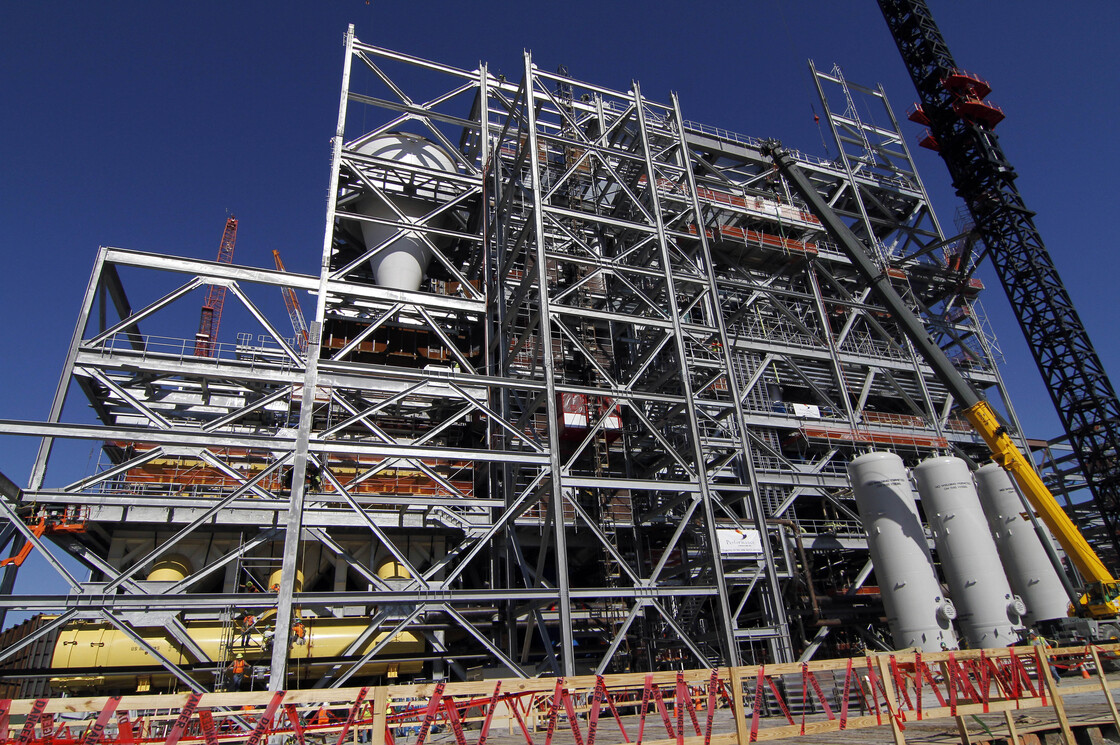 The gasifier facility, still under construction at Mississippi Power's Kemper County energy plant on Nov. 13, 2012. Under the EPA's proposed rules, new plants that run on coal would have to find ways to emit less than half the carbon dioxide current coal plants emit.Rogelio V. Solis/AP
The EPA proposal aims to help The White House meet its plan to cut greenhouse gas emissions by attacking the largest single source in the United States: Power plants pump out 40 percent of the nation's greenhouse gases.
The EPA's new proposal sets a limit for future power plants of 1,000 pounds of carbon dioxide per megawatt-hour for large electricity generators that are powered by natural gas. And it sets a slightly higher limit of 1,100 pounds of CO2 per megawatt-hour for small natural gas generators and for coal-fired generators.
Although the EPA says its rule is legally sound, electric utility companies are already arguing that it goes further than the law allows.
The only technologies that exist to make coal plants clean enough to meet this proposed standard, industry executives say, are far too expensive and haven't been proven at a commercial scale. Making coal plants clean enough, they say, would add hundreds of millions of dollars to the already steep price tag of coal plants.
"Our customers have to agree to foot that bill," says Nick Akins, president and CEO of American Electric Power, one of the country's largest utilities.
Akins says his customers won't go for it.
A few years ago, American Electric Power built a temporary, small-scale project that successfully captured carbon and stored it deep underground at its massive Mountaineer coal-fired power plant in West Virginia. The company proposed building a larger version at the same site and passing the costs on to consumers. But state regulators rejected that project in the end because it would increase electricity costs.
If the EPA's proposal goes forward, Akins says, companies won't build coal plants; natural gas plants are cheaper. But that strategy would make companies and their customers vulnerable to future spikes in natural gas prices, he says.
The revised proposal comes after loud complaints from industry about the first version of the proposed rule, which was released 18 months ago. That initial version proposed one standard for all power plants, regardless of their size, or the type of fuel they use.
Greenhouse gas emissions from the electricity industry already have declined because economic considerations have led utility companies to start turning away from coal. These days, utilities are building natural gas plants and wind farms instead. New technologies for drilling into deep shale deposits have opened up abundant supplies of relatively low-cost natural gas. And subsidies and technological improvements have made wind farms competitive.
Electricity companies fought hard against the EPA's first proposal largely because they see it as as a bad precedent for upcoming regulation of greenhouse gas emissions from power plants that already exist.
President Obama has told the EPA to come up with a proposal by June of 2014 to clean up the older plants. (Even though companies are already developing fewer new coal-fired plants, they're likely to rely on many of the existing coal plants for decades to come).
Environmental groups, too, are closely reading Friday's proposal, hunting for clues to how stringent the administration is likely to be when it turns in 2014 to developing new rules for existing plants.
"The sooner we get these protections in place," says Vickie Patton, general counsel of the Environmental Defense Fund, "the clearer the signal [will be] that new power plants must do their fair share in addressing the heavy burden of carbon pollution on human health and the environment."


 The pirate-themed world in PvZ2
 Familiar faces make an appearance, but there are plenty of new plants to play with, too.
 The game's in-app purchases aren't exactly a high-point.
 A primer: zombies are attacking, and your platoon of sunshine-powered plants are tasked with defending our brains. This time there’s a taco and space travel involved—it’s weird, just download it (Free, iOS only). The animation oozes charm, and you can’t help but smirk as sunflowers smile and laugh, or puffy-cheeked pea shooters rain death on the undead. The music is catchy, and the environments, challenges, and mini-games are as inventive as ever. Most important, you can play through the entire game and earn most of the paywall-restricted goodies without ever dropping a dime, and be treated to a challenging—but fair—experience that honestly eclipses its predecessor.
 The first hit is always free. The trouble starts with Plant Food, a powerup that can supercharge your floral forces, and is dropped by random glowing zombies. You can only carry three at a time, but they flow fairly regularly—until they don’t. The random number god is a fickle beast; in some levels, I had more plant food than I knew what to do with, and would flick it at my minions just to see what it would do. Other levels required a bit more careful management, or simply doing without. And then there are the keys that will unlock doors scattered across the map. They too drop randomly, and while the doors don’t necessarily impede your progress, they do block access to new plants you’ve yet to acquire. And finally there are stars—that basic metric of level completion for today’s mobile games. Complete challenges to unlock stars, and you’ll unlock a gate that’ll take you to the next map. Want more plant food? Just spend 1000 coins, which are occasionally acquired by defeating enemies (at random, of course)—you’ll also get up to 50 coins if you complete a level without any major mishaps. Want more keys? Just keep playing and replaying levels until more drop, and spend them wisely. Naturally, you can just open up your wallet and buy all the coins and keys you’ll need. But I refuse—it’s a shortcut all too akin paying to win, and I’ll be damned if I’ll have that on my conscience. And just like that, everything becomes too awesome to use. I play conservatively, stockpiling plant food and only spending it when I’ve reached the cap and a glowing zombie makes an appearance, securing my supply line. Any keys are simply hoarded—that plant looks pretty nice, but I’ve only got seven of these things and who knows what’ll be available on the next map. But my heart didn’t well and truly sink until I was introduced to the touch-centric powerups. Pinch zombies to pluck their heads off. Swipe them up into the air, and then flick them off the screen. Or press and hold to zap one, then drag your finger across the screen to fry his buddies. Incredibly fun, well-balanced abilities (only active for a few seconds) that serve as a sort of Hail Mary pass when the game is at its most hectic. But they’ll cost you a considerable number of coins—more coins than you’ll earn in fair number of levels. Unlike plant food there’s no way of accruing them “naturally,” so I play knowing that those powerup icons sitting on the bottom of my screen may as well not be there, as I’d feel foolish ever wasting that much currency on them.
 Grind for stars, or shell out the price of a premium app. I paid $20 for the original Plants versus Zombies. And then I purchased it again, for my iPad. And then it was released on the iPhone, which is a lot easier to hold when you're standing on a bus, so there goes a bit more cash—I’m not averse to rendering unto PopCap what’s theirs. But I’m pretty sure I’ll never shell out any cash for Plants versus Zombies 2, and this irks me. What was once a fun, fluid tower defense-esque experience can at times feel more like a sort of a resource management sim—not because of scarce resources, but because those resources cost real money. Still fun, but forever plagued by that nagging sensation that you’re only worried about playing so efficiently because you know you could be wielding awesome power for just a few bucks. And have a full arsenal of plants to choose from—many of them old favorites—for just a few bucks. Look, I love the Snow Pea ($4). But is a single plant really worth as much rymdkapsel?
 To be fair, Snow Pea is pretty great. You can also pay to avoid a hefty amount of repetition: The new time periods are locked behind “star gates,” so you’ll need to hoard stars by playing new challenges on old stages before you can proceed. Or forking over five bucks. To be fair, the nature of Plants versus Zombies’ gameplay means that “stages” are mere backdrops, and no level ever feels the same. But the first game kept things moving at a refreshing pace: A few levels in the backyard begets a night zone with new plants begets a new play dynamic with aquatic-zombies, before heading to the roof for an entirely different experience. Quaint as the Plant versus Zombies 2 experience is, you’ll get sick of hanging around Egypt before too long. This could have been much worse: consider SimCity or Real Racing, series that could once do no wrong rendered nigh unplayable or cynically expensive by decisions aimed at converting every moment of our entertainment into cold hard cash. In Plants versus Zombies 2 we’re never nagged to spend money, or forced to pay to make progress or post quips to Facebook in exchange for extra sunshine or whatever. It’s far more insidious than that, as the very essence of the game involves separating the wheat from the proverbial chaff. “Core” gamers will have their challenge, with a decidedly brisker pace than the original game and challenges to play over and over and occasionally, over again until they’ve perfected their build order. The casual gamer, otherwise known as the family member or friend we introduced the original game to, might instead feel a bit overwhelmed. Perhaps they’ll shell out some cash on powerups to beat a level or two. Or maybe they’ll chuckle at the comical narrative and set the game aside—it was free, after all—wondering what the heck all the fuss was about. Don’t think twice about grabbing this game (unless you don’t own an iOS device, natch). It’s incredibly fun, and free, and well worth your time. But its in-app purchases are worryingly over-priced, and while seasoned gardeners won’t have much trouble, I worry about the precedents it sets.